The drums
The janggu and samul nori: how an hourglass drum reached the stage
The two-headed janggu, its place among the four samul nori instruments and the farmers' music that came first, explained from Wikipedia's records.
Reserve my seat ↗Quick answer
The janggu is a two-headed hourglass drum central to Korean traditional music, and it is one of the four instruments of samul nori, a genre that moved farmers' village music onto the indoor stage in 1978. The booking page for the Onggi Concert names a janggu solo and a janggu dance among its possible pieces, so the drum is the instrument you are most likely to meet. Knowing how it is built and where it comes from makes the evening easier to follow.
An hourglass with two voices
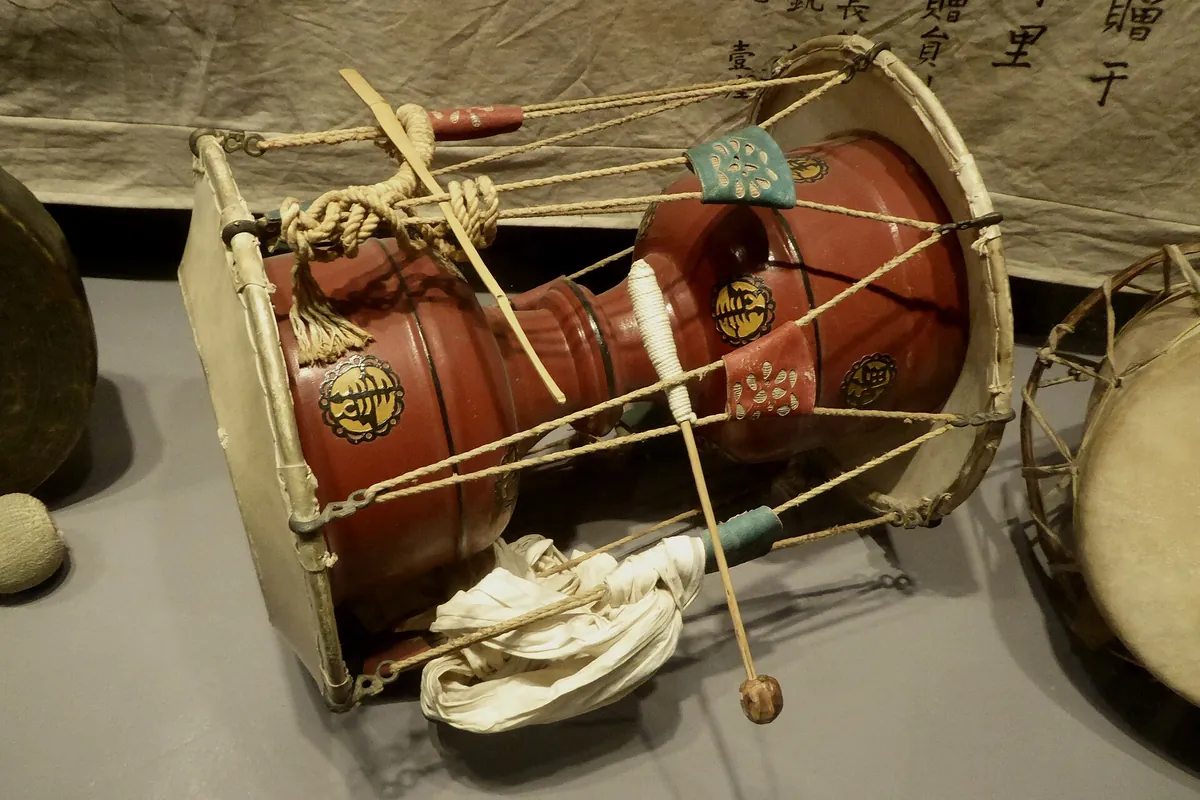
Wikipedia describes the janggu as an hourglass-shaped drum with two heads made from different leathers. The two heads produce different pitch and timbre, and the pairing is believed to represent the harmonious joining of yin and yang. Thick hide on the left head produces the deep notes, while lighter hide on the right head produces the high ones. The round tube linking the two ends, the jorongmok, shapes the tone: a wider tube gives a deeper, huskier sound and a narrower one a harder, snappier sound. Rope counter-loops hold the heads on their metal hoops. The photograph on this page shows a janggu with its sticks in the National Folk Museum of Korea.
How it is played
Traditionally the player holds a thin bamboo stick, the yeolchae, in the right hand for the high head and plays the low head with the bare left hand, an arrangement Wikipedia notes in folk songs and shamanistic rituals. Today it is common to use a mallet, the gungchae, on the low head as well. The article lists syllables the players use to speak the rhythms, such as deong, deok and ta, and describes the janggu as an accompanying instrument prized for its agility with complex rhythms. It can sit on the floor, as in the sanjo tradition, or hang on a strap at the shoulder, and a skilled player can dance while drumming, moving the shoulders with the beat.
Older than it looks
The earliest depictions of the instrument appear on a Silla-period bell and in a mural in a Goguryeo tomb, according to Wikipedia, and the oldest written records come from the reign of King Munjong of Goryeo, as a field instrument. A Goryeo chronicle records twenty janggu given for a banquet in 1114. The drum may have evolved from the smaller yogo, and the article says the instrument reached its present standard size during the Goryeo period. The janggu is used across court music, wind music, folk music and shamanistic music, and in vocal music, dance and yeonhui, the performing-arts division mentioned on the concert's page.
Farmers' music and the first stage show
Samul nori, which means four objects play, is described by Wikipedia as a modern adaptation of the farmers' music nongak and shamanic music for the indoor stage. It uses four instruments: the small gong kkwaenggwari, the larger gong jing, the hourglass drum janggu and the barrel drum buk. Traditionally this music was outdoors and involved elaborate costumed dances, but in samul nori the musicians sit and the emphasis falls on the sound. The article says the first samul nori performance was on 22 February 1978 in a small theatre in Seoul, and that the genre has since been called Korea's most successful traditional music.
Pungmul, the village tradition
Behind samul nori lies pungmul, a Korean folk tradition of drumming, dancing and singing. Wikipedia says most performances are outdoors, with dozens of players in constant motion, and that the form is rooted in dure, the collective labour of farming communities. It was played at village events and rural holidays and to accompany shamanistic rituals and mask dance dramas. Each group is led by a kkwaenggwari player and includes at least one janggu, one buk and one jing. The sit-down, indoor character of a salon concert is therefore a long way from pungmul's open-air roots, which is part of what makes the contrast interesting.
What it means for your evening
The Onggi Concert is not samul nori, and its page does not say that the drums are arranged in that format. What the knowledge gives you is a way to listen: for the difference between a low thud and a high crack from a single drum, for rhythms that repeat and vary, and for the player's body moving with the beat. At the end, when you try the instruments yourself, you may find that holding a steady pattern on two heads at once is harder than it looked.
Frequently asked questions
Will the concert be samul nori?
The page does not say so. It names a janggu solo, a hand-drum dance and a janggu dance among the possible pieces.
What is yeonhui?
Wikipedia lists it among the performing-arts divisions that use the janggu. The booking page uses it for a folk programme.
How many instruments are in samul nori?
Four: the kkwaenggwari, jing, janggu and buk, says Wikipedia.
Sources