The craft
Onggi: the breathing jars behind Korean fermentation
What onggi earthenware is, how it is fired, why cooks trust it with kimchi and soy sauce, and why a concert might borrow its name.
Reserve my seat ↗Quick answer
Onggi are Korean earthenware jars, used for centuries to store and ferment food, whose porous clay lets air move through the wall while keeping liquid in. Wikipedia says they range from unglazed pots fired near 600 to 700 degrees Celsius to dark-glazed ones fired above 1,100, and that they carry the nickname of breathing jars. The concert on this site is named after them, and its booking page credits the jars with giving the room natural resonance, so a little knowledge of the craft explains the name.
What onggi are
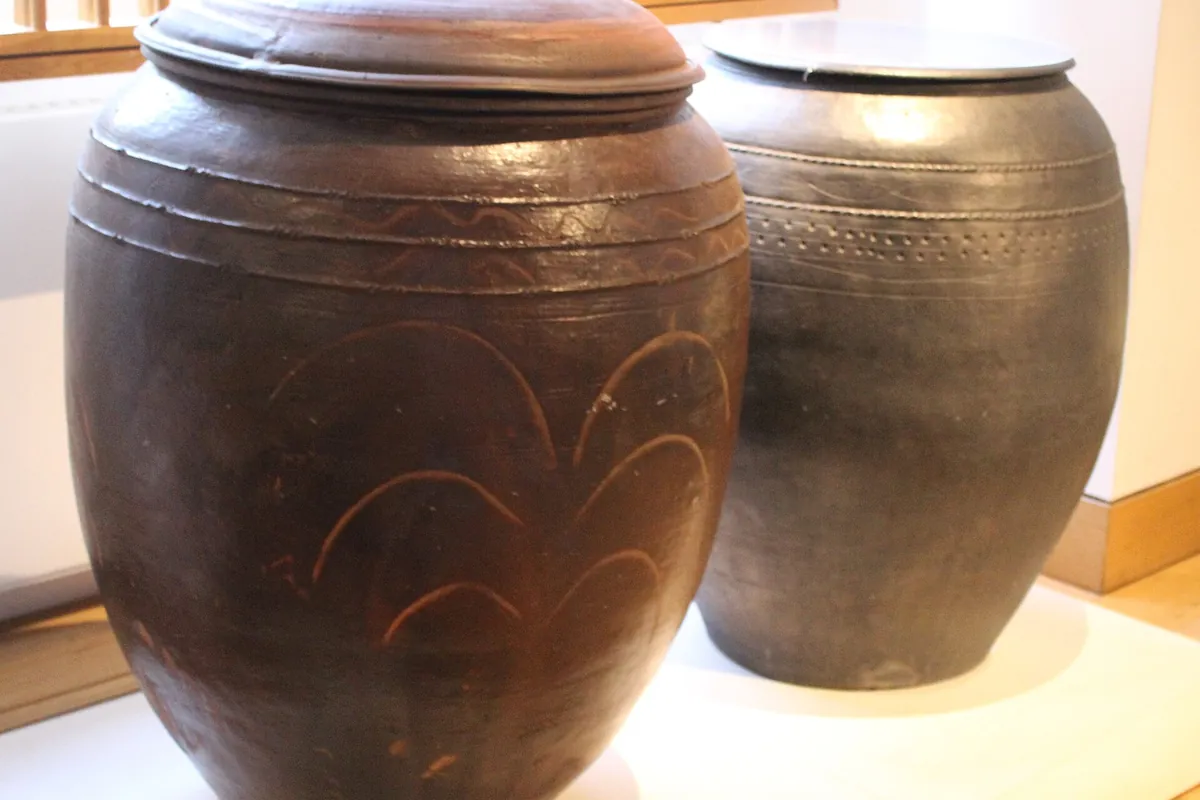
Wikipedia defines onggi as earthenware jars extensively used as tableware and storage containers in Korea. The word covers two broad families: unglazed earthenware fired at roughly 600 to 700 degrees Celsius, and pottery with a dark brown glaze fired above 1,100. By size, they carry different names: danji for the small jars, hangari for the medium ones and dok for the large crocks. The article adds that onggi have been used continuously from prehistoric Korean states to the present day, though today they mostly appear as traditional storage and ornament, and that the modern shape dates from the Joseon era. A museum case of them looks plain, but each reflects the clay, the climate and the habits of its region.
Why the clay breathes
The distinctive feature is porosity. Wikipedia explains that onggi have a more microporous structure than porcelain, and that before firing a large amount of sand is added to the clay body, creating passages for air. A glaze keeps the surface waterproof, so air but not water passes through the pot, a property Koreans describe as onggi breathing. That quality is the reason the jar suits fermentation. Foods commonly made in onggi, the article lists, include gochujang, doenjang, kimchi and soy sauce, and it says a well-made jar can give fermented food an optimally ripe quality. The porosity, in short, is the working principle of the jar and not a flaw.
The jangdokdae and the household
Large onggi were traditionally stored on a jangdokdae, an elevated platform near the house, according to Wikipedia. That detail says something about how central the jars were to daily life: they stood in the open, beside the home, holding the sauces and pastes that flavoured a year of meals. The article notes that Korea has long been known for fermented foods, quoting a passage from the Records of the Three Kingdoms about Goguryeo people having a custom of making fermented foods. Records from the Joseon period also list onggi craftspeople working in institutions, so the trade has a documented history of centuries.
Making a jar
Onggi are made by specialists called onggijang. Wikipedia describes one method in which fine clay is washed to remove sand and impurities, dried in the sun, washed with a lye solution and dried again, before a glaze is applied and a pattern, such as orchid or grass, is drawn on the body. The jar is then air-dried, fired in a kiln and finished. Another method kneads the clay, cuts it into bricks, beats it into planks and builds the form on a wheel, where the speed of the wheel and the movement of the hands decide the shape. The article states that the design of the pots varies by region and climate.
A craft that nearly faded
After the 1960s, the article says, the pottery culture seemed likely to disappear because plastic and stainless-steel containers had arrived. In response, the Ministry of Culture designated onggi a Human Cultural Property in May 1989, and in 1990 the onggijang was designated Intangible Cultural Heritage No. 96. Those two steps are why onggi are still made by hand today, and why festivals and villages devoted to them exist. The jars on show in museums, such as the pair photographed at the British Museum on this page, are the quiet survivors of that rescue.
Why a concert borrows the name
The Humanscale Onggi Concert takes its name from these jars. Its booking page says the room uses no microphones, and that onggi give the performance its natural resonance. A large empty vessel does act as a resonator, so the idea is credible, though this guide cannot verify how the jars are arranged in the room or how much they shape the sound. What the name does tell you is the spirit: a performance meant to feel handmade, close and unamplified, in the manner of a craft that is itself made by hand and valued for what happens inside it. If you enjoy the evening, the jars in a Seoul museum or a Korean kitchen are worth a second look.
Frequently asked questions
Are onggi the same as kimchi pots?
Kimchi is a common food made in onggi, but the jars also hold soy sauce, gochujang and doenjang, says Wikipedia.
What does the booking page say about the jars?
That onggi give the performance its natural resonance, so no microphones are used.
Are onggi still made today?
Yes. Wikipedia describes the craft's designation as cultural heritage in 1989 and 1990, which helped it survive.
Sources