Short answer
Is the Onggi Concert in Seoul worth it?
Yes, for anyone who wants to hear Korean drums and dance close enough to feel them rather than watch them from a distance. GetYourGuide shows a rare 5.0 across 65 reviews, priced from roughly US$94 a guest, for a salon-sized performance with thirty seats. If you would like a spectacle on a big stage, this is a different and smaller thing, and its charm is the closeness.
Points to weigh
What the price buys
The page lists a performance with English commentary, tea and sweets at your own table, an artist talk with photos, and time afterwards to try the instruments and pose in hanbok. Treat the extras as part of the evening, not as add-ons.
Why no microphones
The listing says onggi, the large earthenware jars of Korean kitchens, give the room its resonance, so drums and voices travel unamplified. Wikipedia explains that onggi are porous enough to let air through, which is why they suit fermenting food; the page leans on the same craft for sound.
Two possible programmes
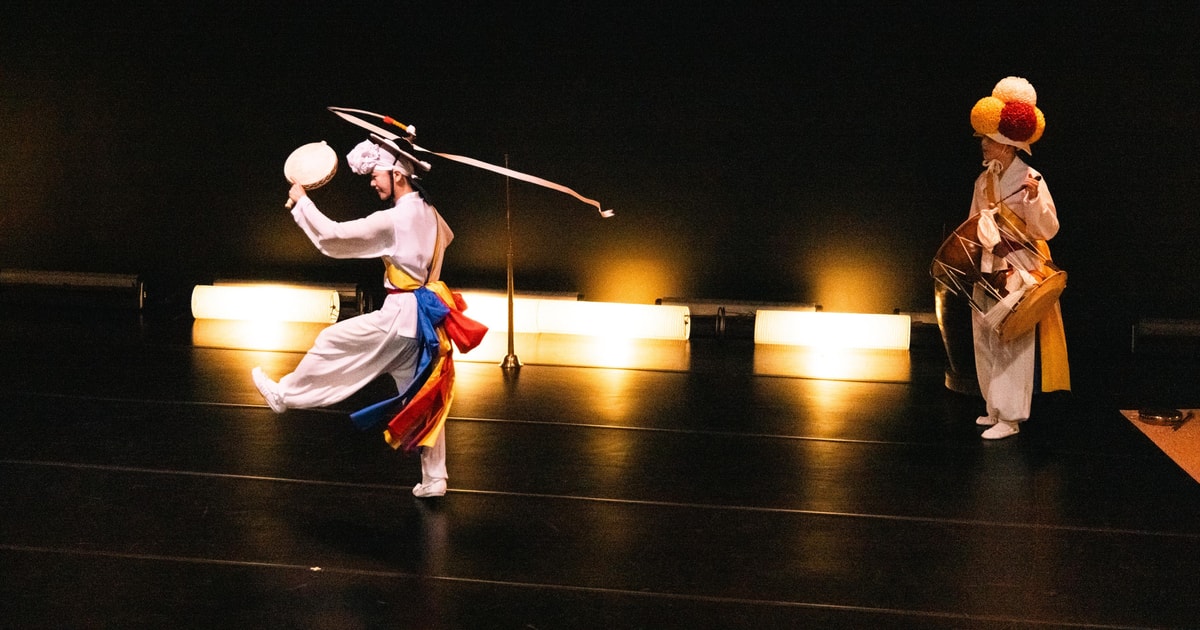
By date, the page says you see either a folk performance (yeonhui), with a janggu drum solo and a hand-drum dance, or traditional dance: the salpuri scarf dance, a court sword dance and a janggu dance. It does not let you choose, so the calendar decides.
Who it suits
Curious travellers, couples, and anyone who prefers a small room to a theatre. It is poor value for someone who wants a full-length, multi-act show, because the performance itself runs about fifty to sixty minutes.
Finding it
The listing places the room at Gwangmudae, on the ninth floor of Building N in the Dongdaemun Shopping Complex, on a site that once housed a traditional arts theatre. Leave a few minutes to find the lift.
Booking terms
Cancelling is free, as the page states, and you pay nothing today. Terms for your own date appear in the calendar and again in the confirmation message.
Seven things behind the sound
Seven things behind the sound: jars, drums, dances and a district
A salon concert is built from older things: a clay jar, an hourglass drum, two dances and a city gate. Each card condenses what Wikipedia records about one of them; the booking page names few of these things itself.
-
The jar
Earthenware that lets air through
Wikipedia describes onggi as earthenware jars used as tableware and storage in Korea, some unglazed and fired at roughly 600 to 700 degrees Celsius, others dark-glazed and fired above 1,100. Their microporous body is why Korean cooks ferment soy sauce, gochujang and kimchi in them, and why people speak of the jar as breathing.
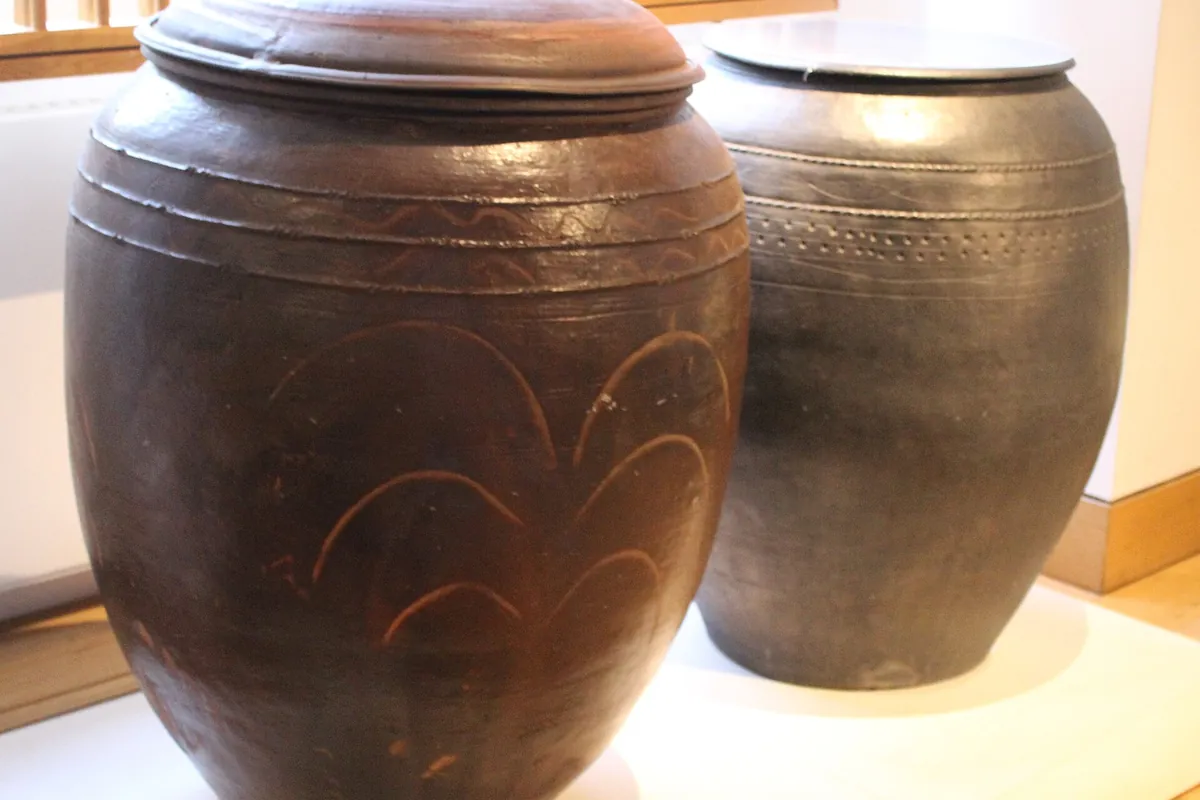
Two large onggi jars on display at the British Museum. -
The jar's kitchen
Fermenting beside the house
Large onggi traditionally stood on an elevated platform near the house called a jangdokdae, says Wikipedia, and the craftspeople are called onggijang. A craft that looked likely to fade after the 1960s was designated a Human Cultural Property in May 1989, and the onggijang became Intangible Cultural Heritage No. 96 the next year.
-
The drum
An hourglass with two voices
The janggu has two heads of different pitch and timbre, which Wikipedia says are believed to represent the harmonious joining of yin and yang. The left head, covered in thick hide, gives low tones, and the right head, in lighter hide, gives high ones. Traditionally a player strikes the right head with a stick and the left with a bare hand.
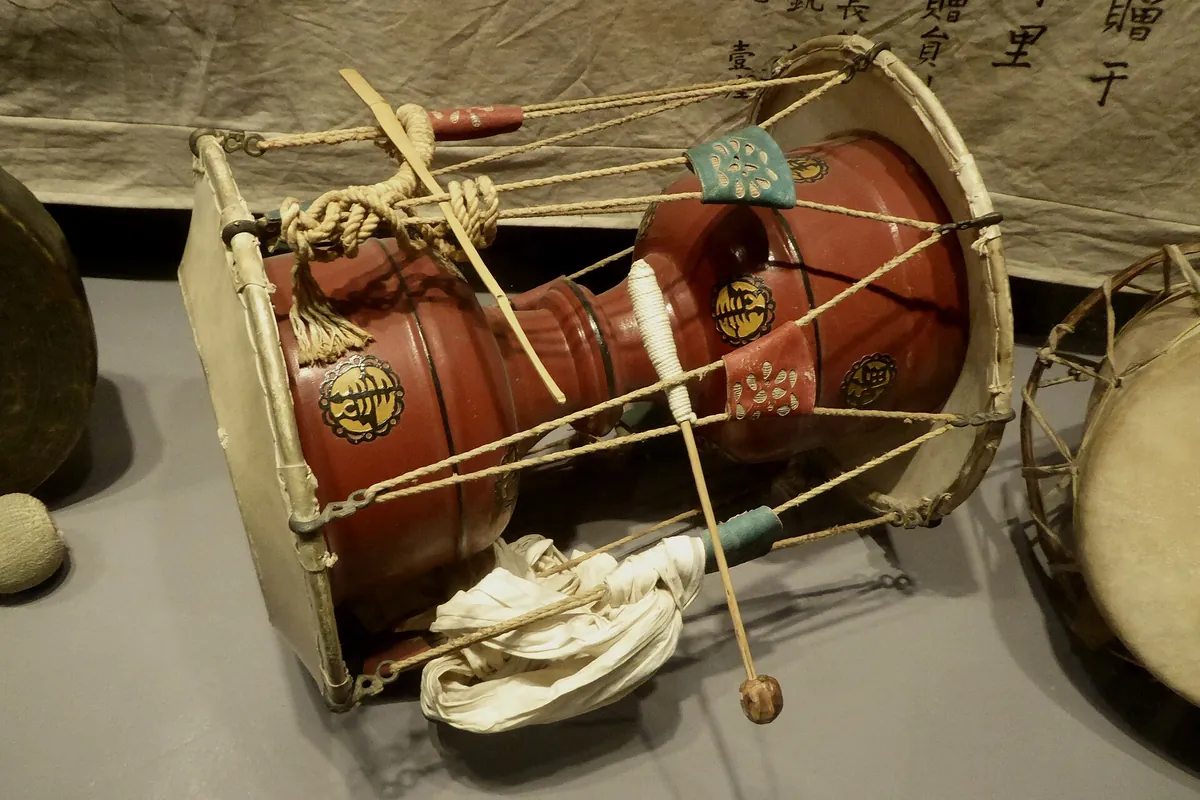
A janggu with its two sticks, in the National Folk Museum of Korea. -
The ensemble
From the field to the stage
Wikipedia calls samul nori a modern adaptation of farmers' music, nongak, for the indoor stage, played on four instruments: the kkwaenggwari, the jing, the janggu and the buk. Its first performance, it says, took place on 22 February 1978 in a small Seoul theatre. Pungmul, the village tradition behind it, is outdoor music with dozens of players in constant motion.
-
The scarf
Salpuri, a long cloth drawn through space
Wikipedia's article on Korean traditional music calls salpuri a shamanistic ritual dance, described as simple and serene, in which a long scarf traces fluid lines that extend the dancer's arms and fingers across the stage. The booking page names a scarf dance among its possible pieces.
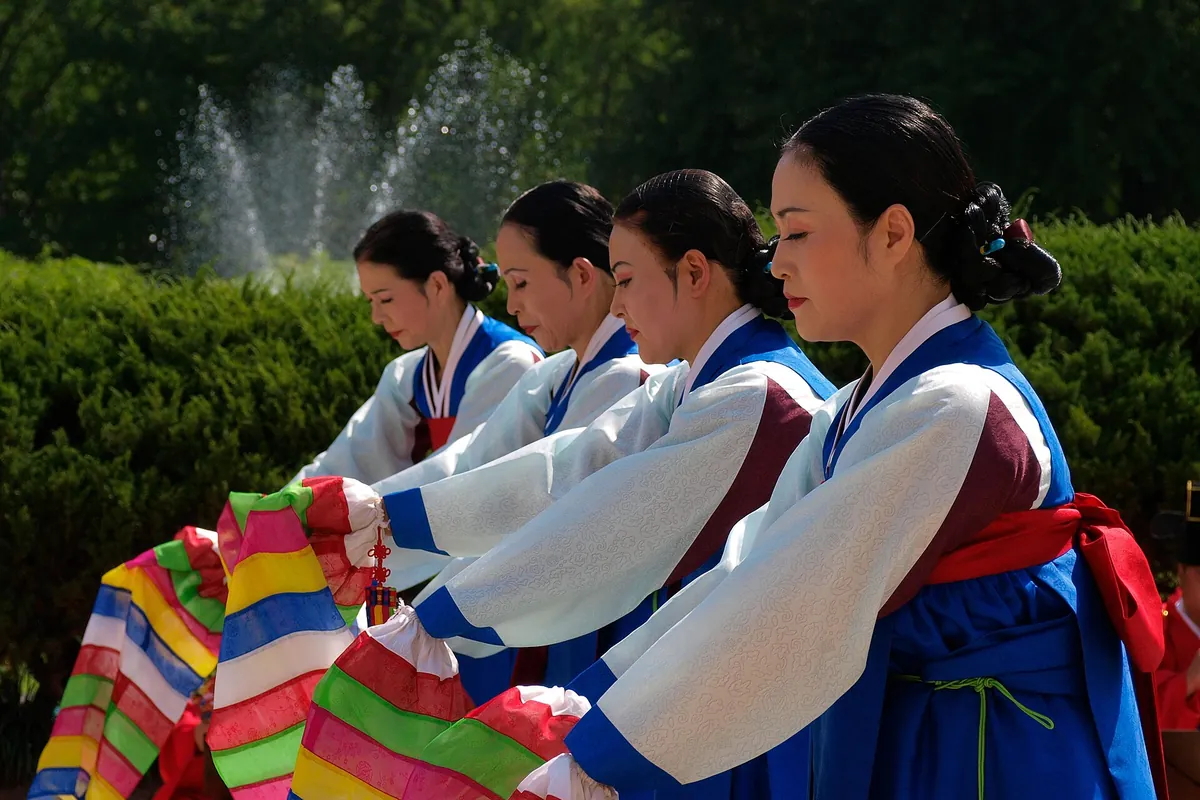
Korean dancers in hanbok with striped sleeves, photographed outdoors. -
The sword
Geommu and its sleeves
Geommu is a sword dance whose court version is called Jinju geommu, says Wikipedia, with emphasis on the movement of the costume sleeves and a pair of replica short swords. It was rearranged by the royal court in the Joseon period and is treasured as South Korea's 12th Important Intangible Cultural Property. The page lists a court sword dance without saying which version.
-
The district
Dongdaemun, the Great East Gate
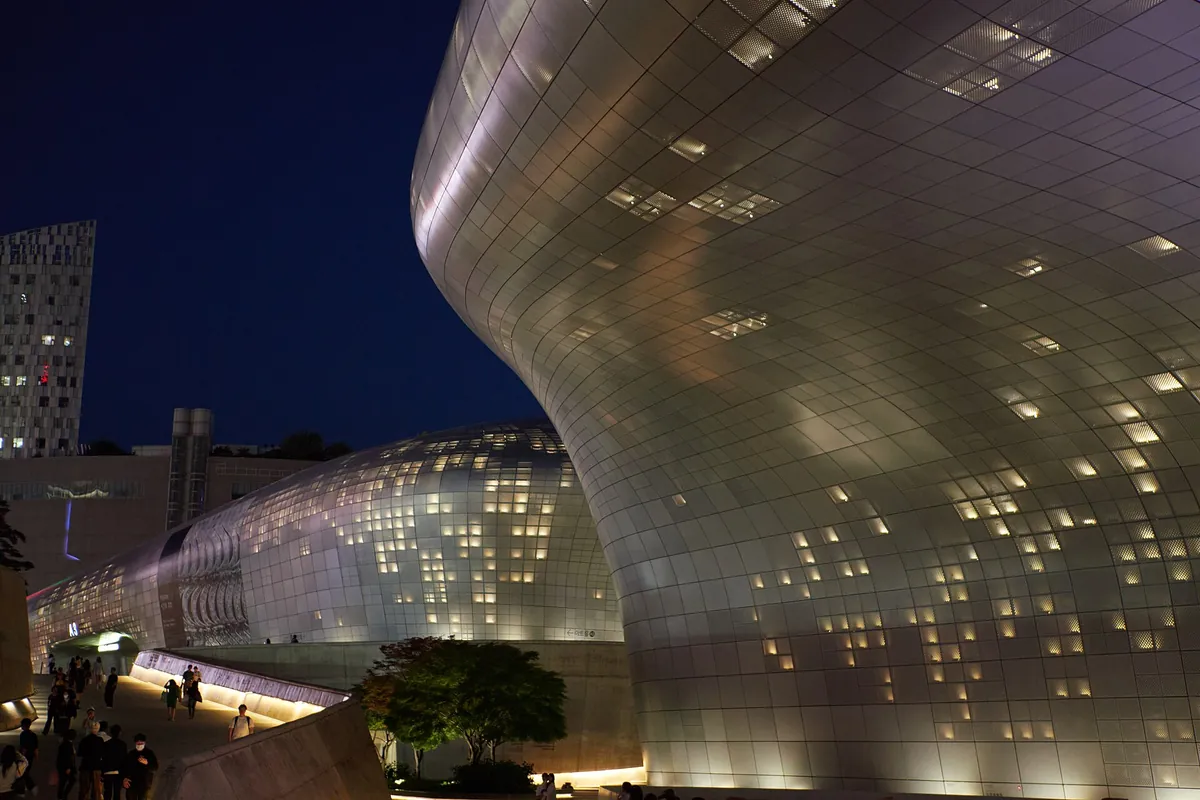
Heunginjimun, also called Dongdaemun, is one of the Eight Gates of the Seoul City Wall, first built in 1398 and rebuilt in its present form in 1869, says Wikipedia. The Dongdaemun Design Plaza, designed by Zaha Hadid, now stands on the site of the old Dongdaemun Stadium and opened on 21 March 2014.
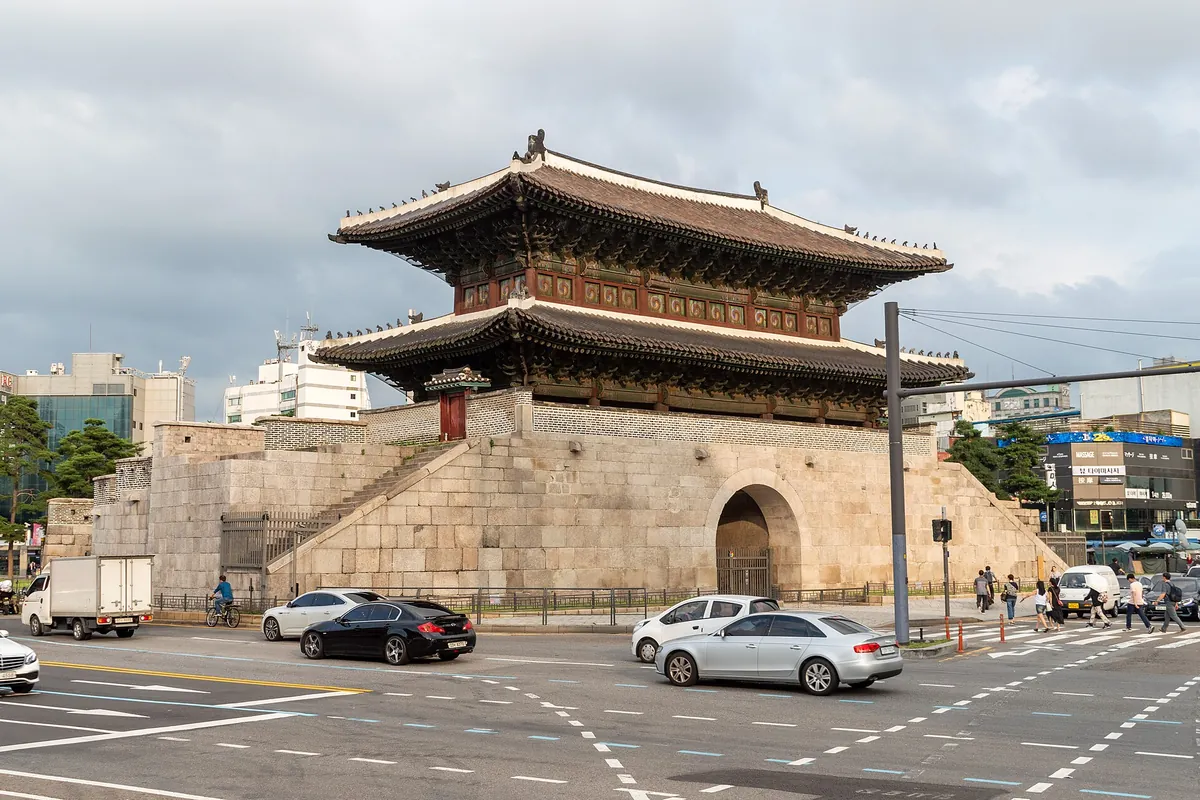
Heunginjimun, the Great East Gate of Seoul's old city wall.
Sources: Wikipedia on onggi, the janggu, samul nori, pungmul, geommu, Korean traditional music, Heunginjimun and the Dongdaemun Design Plaza, plus the booking page. The page publishes no running order, so these cards describe the traditions, not a promised programme.
From a city gate to a design plaza
Seven dates from Dongdaemun and its sound
- 1398
Heunginjimun, the Great East Gate, is first built under King Taejo
The source: Wikipedia dates the first structure to the fifth year of his reign, 1398
- 1869
The gate is rebuilt in the form that stands today
The source: Wikipedia says the current structure is the one rebuilt in 1869
- 1905
Dongdaemun Market opens in Yeji-dong
The source: Wikipedia dates the opening to July 1905
- 1925–2007
Dongdaemun Stadium hosts national sports and celebrations until it is demolished
The source: Wikipedia's article on the Dongdaemun Design Plaza gives these years
- 1978
The first samul nori performance is staged in a small Seoul theatre
The source: Wikipedia gives 22 February 1978
- 1989–1990
Onggi making is designated a cultural property, and the onggijang an Intangible Cultural Heritage holder
The source: Wikipedia gives May 1989 and 1990, listing No. 96
- 2014
The Dongdaemun Design Plaza is inaugurated on the stadium's site
The source: Wikipedia dates the inauguration to 21 March 2014
The booking page, line by line
What the page lists, and what it omits
Every line below reflects the page as read on 19 November 2026. Wherever the page is quiet, this guide is quiet too, and the confirmation message is the last word.
Open the calendar ↗The lowest price found when this page was written; the calendar shows what your own date costs in your currency.
- The room
- Gwangmudae, ninth floor, Building N of the Dongdaemun Shopping Complex, on a site that once held a traditional arts theatre, says the page. Thirty guests a performance.
- The sound
- No microphones. The page credits onggi earthenware jars with the natural resonance.
- The programme
- A folk performance (yeonhui) with a janggu solo and hand-drum dance on some dates, or traditional dance on others: salpuri, a court sword dance and a janggu dance. English commentary throughout.
- The table
- Tea and sweets are served at your own table. The page lists no meal.
- After the music
- An artist talk and photos, then a chance to try the instruments and have photos taken in hanbok.
- Length and terms
- About two hours in all, with the performance itself near fifty to sixty minutes. Free cancellation and payment later, with the terms for your date in the calendar.
A concert or a night walk
An Onggi Concert or a night-time hidden gems walk?
Book the concert, then plan the rest of Seoul
Other Seoul bookings that pair well
The concert fills one evening. Three more Seoul bookings go well with it: a two-hour night walk with a local historian, and two long day trips to the Korean Demilitarized Zone.
- See dates ↗
Humanscale Onggi Concert
An unamplified traditional performance for thirty guests in Dongdaemun, with English commentary, tea and sweets at your table, and a chance to try the instruments.
- See dates ↗
Nighttime hidden gems walking tour
A two-hour guided walk with a local historian, as its page describes it. The natural alternative for a Seoul evening, outdoors and on foot.
- See dates ↗
DMZ, Third Tunnel and suspension bridge tour
A long day trip to the border zone, as its title puts it. Rated by more than ten thousand guests.
- See dates ↗
DMZ tour with JSA museum and defector talk
A second border-zone day, named in its title, for the morning after the concert.
Also bookable in Seoul
Four steps before you go
Four steps before you go
Choose the date, then read the option
The programme changes with the date, between a folk performance and a dance programme. Look at the option on the calendar before you choose, and take the confirmation message as the final word.
Leave time to find the room
The room sits on the ninth floor of Building N in a large shopping complex, so give yourself a margin to find the building and the lift. The confirmation message carries the meeting details.
Come ready to take part
The page promises a chance to try the instruments and wear hanbok afterwards. Wear something you are happy to be photographed in, and ask the host about anything else on the night.
Fit the rest of the trip around it
A night walk suits an evening on its own, and the two border-zone trips listed here each fill most of a day, so keep them away from a late night.
Jars, drums, dancers and the neighbourhood
Dancers, a drum, two jars and the neighbourhood
Photographs from Wikimedia Commons: Korean dancers in hanbok, a janggu in a museum, two onggi jars, the Great East Gate and the Dongdaemun Design Plaza at night. They stand in for the traditions and places discussed in the guides; none shows the venue.
Six deeper reads
Six reads on the jars, the drums and Dongdaemun
- Start here Is the Onggi Concert in Seoul worth it? A 5.0 from 65 guests, weighed An unamplified Korean performance for thirty guests, weighed on what the booking page states: who it suits, what the programme might be and how to decide. Read →
- The comparison An Onggi Concert or a night-time hidden gems walk: which Seoul evening? A seated, unamplified performance for thirty guests against a two-hour guided walk after dark, compared on format, length, price, effort and who each suits. Read →
- The craft Onggi: the breathing jars behind Korean fermentation What onggi earthenware is, how it is fired, why cooks trust it with kimchi and soy sauce, and why a concert might borrow its name. Read →
- The drums The janggu and samul nori: how an hourglass drum reached the stage The two-headed janggu, its place among the four samul nori instruments and the farmers' music that came first, explained from Wikipedia's records. Read →
- The dances Salpuri and geommu: the scarf dance and the sword dance explained What Wikipedia records about two Korean dances the concert's page names, the long-scarf salpuri and the sword dance geommu, and what to watch for in each. Read →
- The neighbourhood Dongdaemun: the Great East Gate, the market and the Design Plaza The district around the concert room, from a gate first built in the 14th century to a market that opened in 1905 and a design landmark finished in 2014. Read →
FAQ
Questions worth settling before you choose an evening
Is the Onggi Concert in Seoul worth it?
For a small, close performance, yes. Its 65 reviewers average a perfect 5.0 on GetYourGuide. It is a salon of thirty seats, not a big-stage show, and the charm is the closeness.
Which programme will I see?
The page says it depends on the date: either a folk performance (yeonhui) with a janggu solo and hand-drum dance, or traditional dance with the salpuri scarf dance, a court sword dance and a janggu dance. Check the option on the calendar.
Why are there no microphones?
The page says onggi, large earthenware jars, give the room natural resonance, so the sound is not amplified. Wikipedia explains onggi are porous and allow air through.
How long does it last?
The page text describes roughly two hours from start to finish, with the performance itself near fifty to sixty minutes. The widget header shows one hour, so check the option for your date.
Is any food included?
Tea and sweets at your own table are listed. The page lists no meal, so plan dinner separately.
Where is it?
The listing says Gwangmudae, on the ninth floor of Building N in the Dongdaemun Shopping Complex. The confirmation message carries the meeting details.
Which language does the host use?
English, for the host and the commentary, according to the page.
Can I take photos?
The page lists an artist talk with photos and photos in hanbok afterwards. It says nothing this guide can quote about filming during the performance, so ask the host.
Can I change my mind after booking?
Yes, cancelling is free according to the page, and nothing is charged today. Your calendar date and confirmation spell out the terms.