The dances
Salpuri and geommu: the scarf dance and the sword dance explained
What Wikipedia records about two Korean dances the concert's page names, the long-scarf salpuri and the sword dance geommu, and what to watch for in each.
Reserve my seat ↗Quick answer
Salpuri is a slow solo dance built around a long scarf, and geommu is a group sword dance in which sleeves and a pair of replica swords carry the drama. The Onggi Concert page names a salpuri scarf dance and a court sword dance among the pieces you might see, depending on the date. Neither is guaranteed on a given night, but knowing what each looks like turns a pleasant evening into an informed one.
Which dances the page names
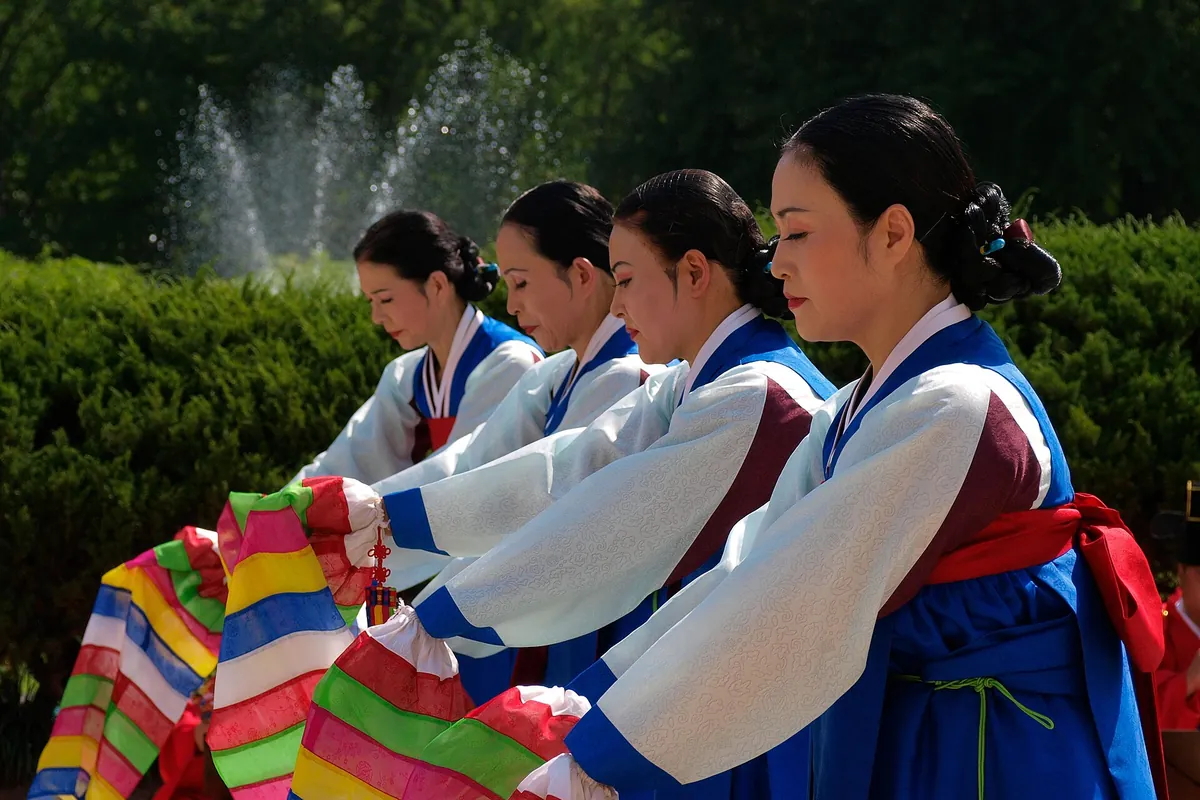
By date, the booking page says, the concert offers either a folk performance with a janggu drum solo and a hand-drum dance, or traditional dance: the salpuri scarf dance, a court sword dance and a janggu dance. It does not say which dates carry which programme, and it does not say which version of the sword dance is performed, so this guide describes the traditions as Wikipedia records them and leaves the running order to the calendar and the host.
Salpuri: a scarf drawn through space
Wikipedia's article on Korean traditional music describes salpuri as a shamanistic ritual dance, conducted as an exorcism of bad spirits, whose style is simple and serene. Its signature is the long scarf. The article says the scarf's fluid lines extend the long lines of the dancer's arms and fingers from corner to corner of the space, so the dancer uses the full room. In a small salon, that means the scarf passes close to the audience and the stillness between movements matters as much as the movements. Watch the hands and the hang of the cloth, and notice how the dancer lets a pause finish a gesture.
Geommu: a sword dance with a legend
Geommu, also spelt gummu or kommu, is a traditional sword dance practised in Korea, says Wikipedia. It is known for its grace, with extra emphasis on the movement of the costume, notably the sleeves, in harmony with the dancer's body. The swords are replica dual short blades that keep to the dance's militaristic origins, and between blade and handle sit three rings that make sounds as the dancers move. According to legend, the dance originated around 660 AD in the Three Kingdoms period, with a young Silla boy named Hwangchang. The article treats the story as legend, not as a recorded event.
From court to concert
Surviving as a folk dance, geommu changed considerably during the Joseon dynasty, says the article, when it was rearranged by the royal court and recreated by the kisaeng. The court version is called Jinju geommu, and the dance has remained primarily a women's dance. It is a group dance performed by six to eight dancers, with three typical motions: two rows facing each other, a kneeling version of the same rows, and a circle that rotates. The article adds that geommu is treasured as South Korea's 12th Important Intangible Cultural Property. The booking page does not say which form the concert uses.
The costume as part of the dance
Hanbok, the traditional Korean clothing, is the basis of the geommu costume. Wikipedia describes hanbok as made up of a jacket, trousers, a skirt and a coat, with modern versions usually modelled on Joseon-period dress. Geommu dancers wear hanbok with an overcoat, a belt and a military-style cap, forming a stylised version of a Joseon military uniform, in colours that traditionally include blue, red, yellow, green and black. The Jinju region's version has a blue skirt and a jade-green jacket. After the concert you can try hanbok on, according to the page, which is a good moment to notice how the sleeves move.
How to watch
Treat the dances as an invitation to slow down. Salpuri rewards patience, since its drama is in what the dancer withholds. Geommu rewards watching the group, because the patterns of rows and circles matter as much as any single dancer. Both lean on rhythm, which at this concert is likely to come from drums played a few steps away with no amplification. Ask the host about anything you want explained, and remember that the page promises English commentary and an artist talk, so questions are part of the evening.
Frequently asked questions
Will I definitely see salpuri?
No. Programmes change by date, and salpuri is only one of the pieces the page lists.
What is the difference between salpuri and geommu?
Salpuri centres on a long scarf and a single dancer in a serene style, while geommu is a sword dance, usually performed by a group.
Is the sword dance the court version?
The page says court sword dance and does not name a version. Wikipedia calls the royal court form Jinju geommu.
Sources